The west facing room nobody sits in after three o'clock
Most people ask us for a darker blind when what they actually needed was a different kind of light.
September 6, 2026 · 4 min read
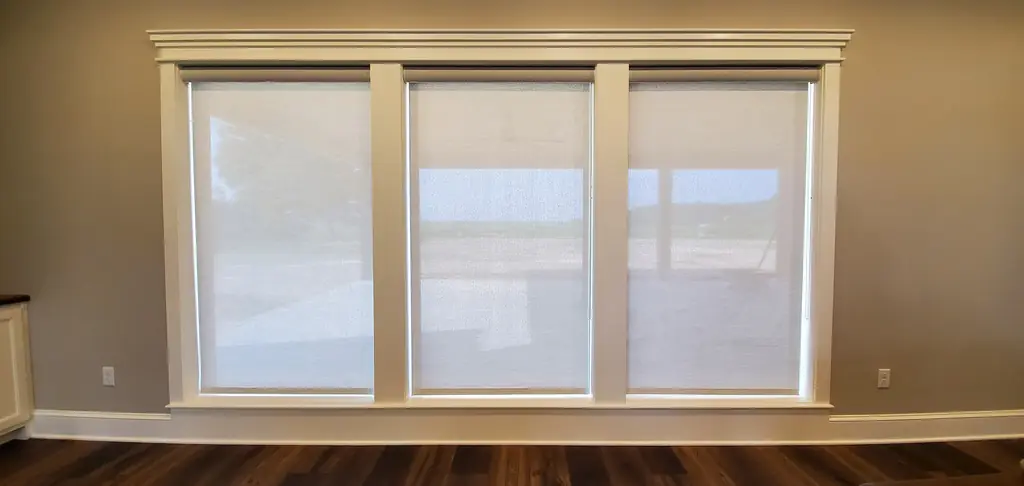
There is a room in a lot of Central Arkansas houses that works perfectly well until about three in the afternoon, at which point everybody quietly leaves it. The television washes out. The sofa gets uncomfortably warm. Somebody squints at a laptop and gives up. By six it is fine again, and because it is fine again nobody does anything about it until the next summer.
When people come to us about that room they almost always ask for the same thing, which is something darker. It is a reasonable instinct and it is usually the wrong purchase, because the room is not suffering from one problem. It is suffering from one of three, and the three take different answers.
Glare, heat and privacy are not the same thing
Glare is a contrast problem. It is light bouncing off a screen, a glass table or a pale wall so that your eye cannot settle. What glare needs is the light diffused and knocked down, not removed. If you black the room out entirely you have swapped a bright room you cannot use for a dark one you also will not use.
Heat is solar gain. The energy is coming through the glass and being released into the room, and the important thing about it is where it gets stopped. A treatment that blocks the light after it has already passed through the window has let most of the heat in already. That is why the openness and the reflectivity of the material matter more than how opaque it looks when you hold it up.
Privacy is a sightline problem, and the thing people forget is that it reverses at dusk. A material you can comfortably see out of during the day is a material people can see into once your lights are on and the sun has gone. Any conversation about privacy has to specify which time of day it is about, or you will solve half of it.
Why the blackout shade so often ends up permanently up
Here is the pattern we see repeatedly. A homeowner puts a heavy room darkening shade on a west facing living room. It absolutely stops the four o'clock glare. It also removes the view, the daylight and the reason the room has a big window at all. Within a month the shade lives in the up position and the original complaint is back.
The alternative on that specific window is usually a solar screen. A solar screen is a mesh with a stated openness, and it works by cutting the glare and a meaningful share of the heat while staying transparent enough that you keep looking out at the yard. The room stays daylit and stays usable, which is the outcome that was actually wanted. It does less for you after dark, so on a room where evening privacy also matters it often gets paired with something else.
A quick way to work out which one you have
- Stand in the room at the hour it is worst and look at what is uncomfortable. If it is your eyes, it is glare. If it is your skin and the room feels close, it is heat. If it is neither and you just feel watched, it is privacy.
- Put your hand flat on the inside of the glass. If it is noticeably warm, you have a solar gain problem that a fabric hung inside the room will only partly fix.
- Go outside after dark with the lights on and look back at the window. That tells you the truth about evening privacy far better than guessing does.
- Note whether the problem is the whole room or one seat. A single bad seat is often a glare bounce and can be solved with far less covering than you think.
What tends to suit what
Solar screens are the specialist for hot, bright glass and they suit sunrooms, porches and wide south or west facing banks of windows. Cellular and honeycomb shades trap a layer of air against the glass, so they are the pick when a room runs cold in January as well as hot in July, and they come in light filtering and room darkening. Roller shades are the quiet, disappearing option and they run from near sheer to full blackout. Shutters give you the most control of all, because tilting a louver lets you throw light up at the ceiling and keep it out of your eyes, which is a thing no roller can do.
For a bedroom the calculation is different again, because there the blackout really is the point, and a room darkening cellular or a shutter with a good closure is doing exactly what it should.
Before you order anything
Describe the room rather than the product. Which direction does it face, what time is it unusable, what are you doing in there when it bothers you, and does it need to work after dark. Four answers and the shortlist gets short. We make everything to order at the shop on Highway 16 in Pangburn, so the width will be your window's width either way, but the material decision is the one that determines whether you like the room again.
If you want to talk one through, call us on (501) 230-2631. Estimates are free, and we cover Cleburne, White, Independence, Van Buren, Faulkner, Pulaski, Lonoke and Searcy counties.
Suzie's Blinds — (501) 230-2631
Call (501) 230-2631More articles
Wood or faux wood: the decision that gets made in the wrong room
The most common blind failure we are called about is not a fitting fault at all. It is the right material in the wrong room.
What made to order actually means when the workshop is the shop
Older houses are rarely square, and that is the difference between a treatment that fits and one that nearly fits.