Wood or faux wood: the decision that gets made in the wrong room
The most common blind failure we are called about is not a fitting fault at all. It is the right material in the wrong room.
September 6, 2026 · 4 min read
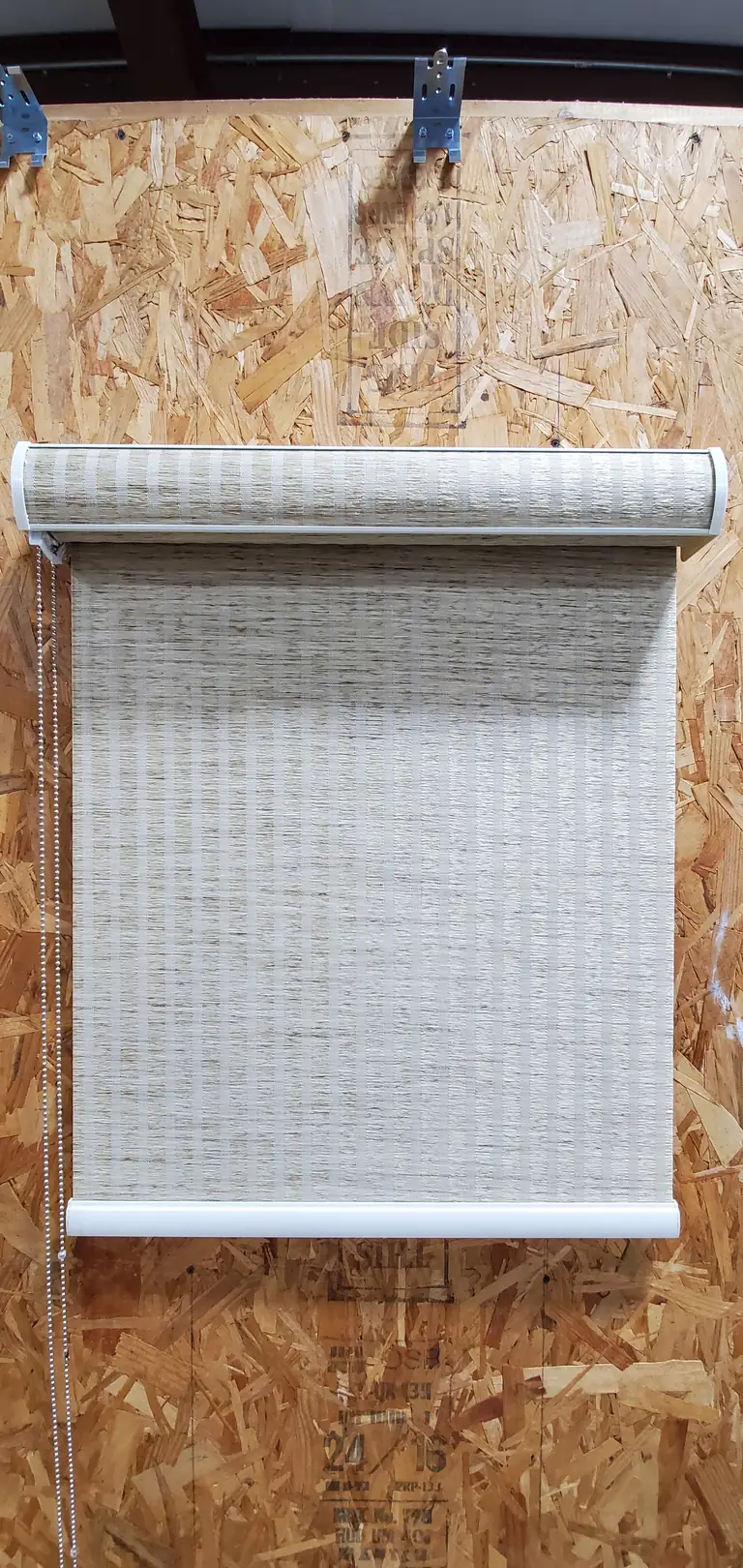
People choose blinds by looking at samples, which is completely natural and slightly misleading. Held side by side on a counter, a real wood slat and a good faux wood slat are a question of grain and warmth, and the wood usually wins. Put the same two slats in a bathroom for eighteen months and it is not a close contest any more.
What actually goes wrong with wood in a wet room
Wood is hygroscopic, which is a long way of saying it takes on and gives up moisture from the air around it. In a living room that is a non event. In a bathroom that gets a hot shower twice a day, or a kitchen where a pan is boiling under the window, the slat absorbs moisture unevenly. The face nearest the room takes on more than the face nearest the glass, the two sides expand by different amounts, and the slat cups along its length.
Once a slat has cupped it does not come back. The visible result is a blind that will not close cleanly, because the curved edges no longer stack flat against each other, so you get a thin line of light between every slat exactly when you wanted the room private. People often assume the blind was hung badly. It was not. It was asked to live somewhere it could not.
Heat does a related thing. A blind behind glass on a west facing window sits in a genuinely hot, dry pocket of air for hours a day, and over a few summers that can open up the joints on a wide slat and take the finish with it.
Where faux wood earns its place
Faux wood is a composite, and its virtue is that it is dimensionally stable in humidity. It will sit in a bathroom, over a kitchen sink, in a laundry or in a mud room and stay flat. It also wipes down, which matters more than people expect near a cooker, where a fine film of cooking grease builds up on everything and a real wood finish resists cleaning far less happily than a composite does.
The trade off is weight. Faux wood is heavier than real wood for the same size, and on a very wide window that weight has to be considered in how the blind is built and supported. That is a specification question, and it is one of the reasons a made to order blind behaves differently from a boxed one: the support is designed for the actual span rather than the nearest standard span.
A room by room shortlist
- Living rooms, dining rooms and bedrooms: real wood, where the grain is part of the room and the air is dry and stable.
- Kitchens, bathrooms, laundries and mud rooms: faux wood, every time, and it is not a compromise.
- Sliding doors and very tall glass: verticals, because a horizontal blind at that size becomes an unwieldy object to lift.
- Where you want a slimmer profile and a harder edge: designer metal, which suits a more contemporary room.
- Anywhere the window is high, wide or over a stairwell: think about how you will actually operate it before you think about the material at all.
The part that is not about material
Two other things decide whether you are happy with a blind, and neither is the slat. The first is the fit. A blind cut to the nearest stock width leaves a gap down both sides of the frame, and at seven in the morning that gap is a bright stripe on your wall whether or not the blind is closed. The second is the headrail. Carry a rail past roughly six feet without proper support and it bows in the middle, so the slats stop sitting level and the blind reads crooked even though it was hung true.
Both of those are set at the measure, not at the fitting, which is why we come out and measure ourselves rather than work from numbers sent to us. While we are there we match the color in the light the room genuinely gets. A white that looks clean under showroom lighting can read grey against a north facing wall, and that is not something a sample chip in your hand will tell you.
Looking after them
A dry dust along the slats every few weeks does most of the work, and faux wood takes a damp cloth for the kitchen film. The one habit worth building is tilting the blind fully closed one way and then the other now and again. That is how you notice a lift cord starting to fray or a tilt wand going stiff, well before it lets go on you.
Everything we supply carries a limited lifetime warranty and we handle the warranty work ourselves, which means you are describing the problem to the people who built and hung the blind rather than to a manufacturer's phone line. If you want a hand choosing, call (501) 230-2631 and tell us which rooms. Estimates are free.
Suzie's Blinds — (501) 230-2631
Call (501) 230-2631More articles
The west facing room nobody sits in after three o'clock
Most people ask us for a darker blind when what they actually needed was a different kind of light.
What made to order actually means when the workshop is the shop
Older houses are rarely square, and that is the difference between a treatment that fits and one that nearly fits.